
Back to the Moon – Artemis II
An Astrogeographical Perspective
Prefer reading in German? Read the German version here.
September 24th, 2026
Space travel has long since become part of our everyday lives. Satellites orbit the Earth, unmanned probes explore the solar system, and humans have been living and working aboard space stations for decades. Yet for more than half a century, no human had ventured beyond near-Earth space and set out for the Moon. Artemis II changed that. Looking at Artemis II through the lens of astrogeography reveals some remarkable geographical connections.
On 1 April 2026, Artemis II launched from Kennedy Space Center in Florida with four people on board. Commander Reid Wiseman, Pilot Victor Glover and Mission Specialists Christina Koch and Jeremy Hansen flew to the Moon and returned to Earth after just over nine days, on 10 April 2026. It was the first crewed journey to the Moon since 1972.
Artemis II was the second step in a sequence of missions through which NASA ultimately aims to return humans to the lunar surface. Artemis I took place without a crew in 2022. Artemis II followed in 2026 as the first crewed lunar mission in more than five decades. Artemis III is planned for 2027 as a crewed demonstration mission in low Earth orbit, designed to test key systems and docking procedures for later lunar landings.
Under current plans, Artemis IV is intended to return humans to the lunar surface in early 2028.
This step-by-step approach is reminiscent of the Apollo missions of the 1960s. Before Apollo 11 became the first mission to land humans on the Moon, Apollo 8 reached the Moon in December 1968 as the first crewed lunar mission. Frank Borman, James Lovell and William Anders orbited the Moon ten times before returning to Earth.
Apollo 8 therefore provides an interesting historical reference point for Artemis II: in both cases, humans reached the Moon as part of a larger lunar programme before a landing was intended to follow on a later mission.
Apollo 8: A First Striking Geographical Connection
Launch: 21 December 1968
Return: 27 December 1968
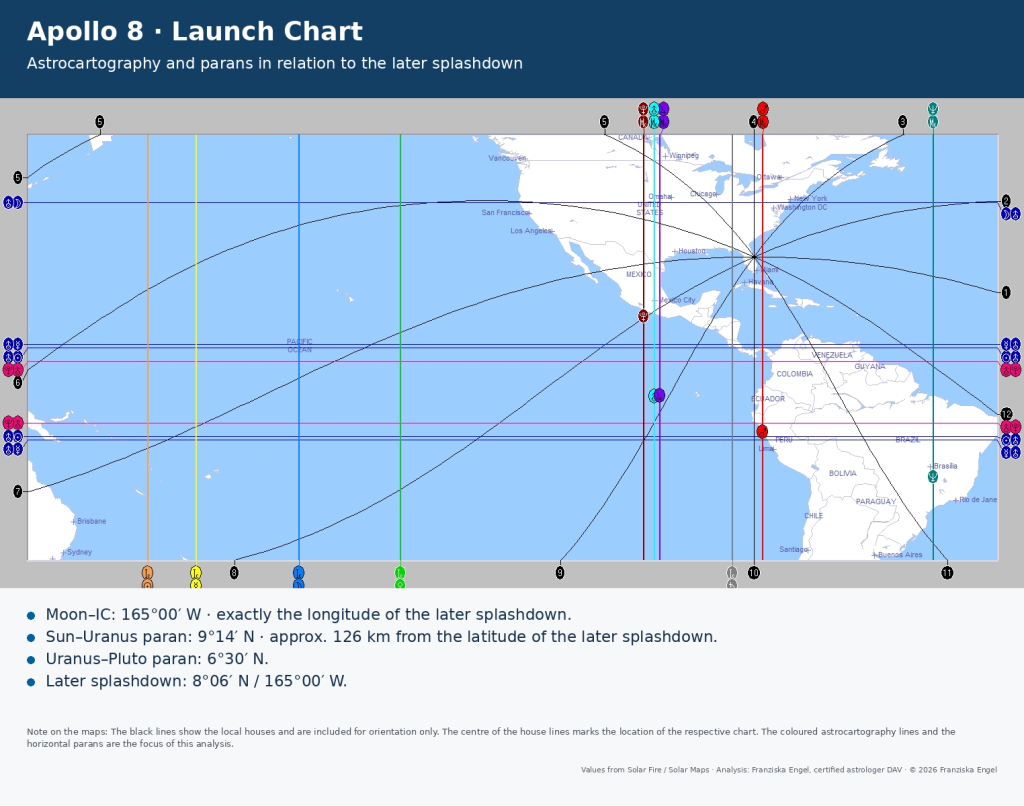
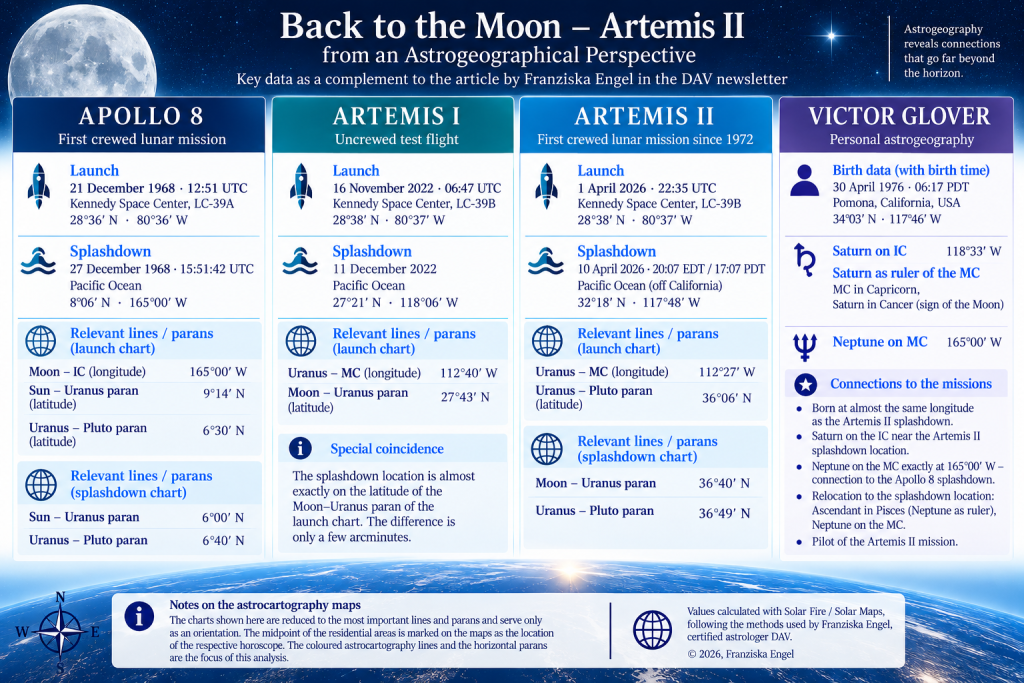
Looking first at Apollo 8 from an astrogeographical perspective, we find a remarkably precise connection between launch and return. In the launch chart of 21 December 1968, the Moon-IC line runs at approximately 165° west longitude. The splashdown took place in the Pacific on 27 December 1968 at approximately 8.1° north latitude and 165° west longitude. The Moon-IC line of the launch chart therefore runs almost exactly through the longitude of the later return location.
While examining the three missions, I also noticed a striking accumulation of connections involving Uranus. For this reason, I specifically examined the Uranus parans for comparison.
A paran in astrogeography refers to a particular latitude at which two planets simultaneously occupy important celestial angles. On a map, a paran therefore appears as a horizontal line extending around the Earth along that latitude.
Already in the Apollo 8 launch chart, there is a remarkable proximity to the later return location. The Sun-Uranus paran lies at 9°14′ N, only about 126 kilometres from the latitude of the later splashdown. The Uranus-Pluto paran lies at 6°30′ N. Together with the Moon-IC line at 165°00′ W, both the longitude and latitude of the later return location are therefore strikingly marked in the launch chart.
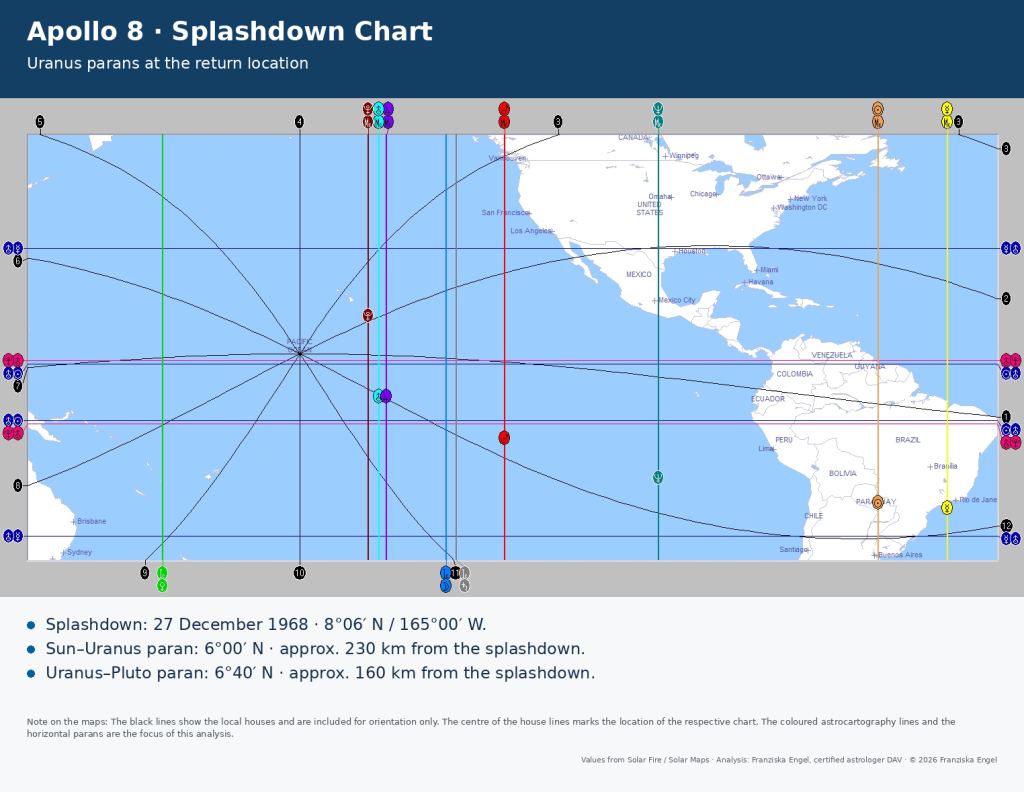
The Uranus connections remain in the same region in the splashdown chart. The Sun-Uranus paran now lies at 6°00′ N, around 230 kilometres from the splashdown, while the Uranus-Pluto paran at 6°40′ N lies around 160 kilometres away.
Thus, already with the first crewed lunar mission, both the Moon and Uranus appear in a direct astrogeographical relationship with the location of the return.
Artemis I: Moon and Uranus Connect Launch and Return
Let us jump forward more than five decades to Artemis.
Artemis I – Launch: 16 November 2022, Return (Splashdown): 11 December 2022
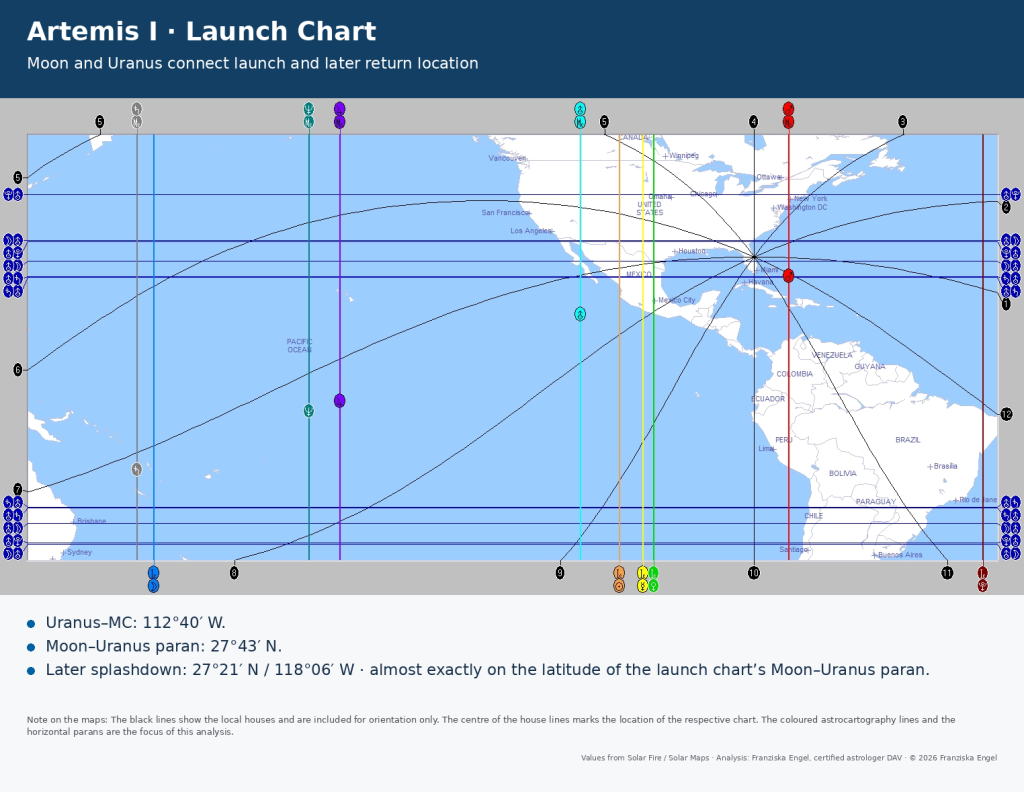
In the Artemis I launch chart, the Uranus-MC line runs at 112°40′ west longitude. This exact longitude will become relevant again when we compare it with Artemis II.
At the level of latitude, the Artemis I launch chart shows a Moon-Uranus paran at 27°43′ N. Artemis I returned to Earth on 11 December 2022 at 27°21′ N. The splashdown therefore occurred almost exactly on the latitude of this Moon-Uranus paran.
In this way, the Moon-Uranus paran of the launch chart connects the starting point of the mission with its later return location.
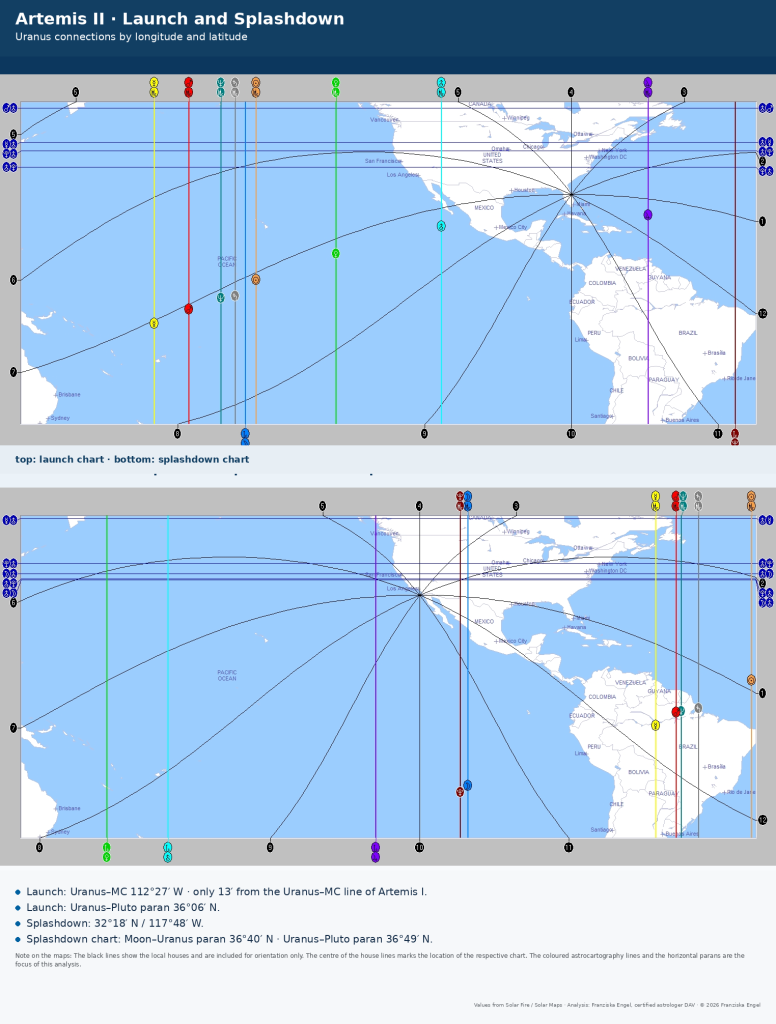
The pattern continues at the level of longitude. At the launch of Artemis II, around three and a half years later and at a completely different time of day, the Uranus-MC line once again falls in almost exactly the same geographical location, this time at 112°27′ W. The Uranus-MC lines of the two launch charts are therefore separated by only about 21 kilometres.
Artemis II: The Geographical Resonances Continue
Artemis II – Launch: 1 April 2026, Return (Splashdown): 10 April 2026
The fascinating connections continue when we consider Artemis I and Artemis II not in isolation, but in relation to one another.
Artemis II returned on 10 April 2026 in the Pacific Ocean off the coast of California. The splashdown occurred at 32°18′ N and 117°48′ W.
Uranus appears again at the level of latitude. In the Artemis II launch chart, we find a Uranus-Pluto paran at 36°06′ N. The splashdown chart has a Uranus-Pluto paran at 36°49′ N as well as a Moon-Uranus paran at approximately 36°40′ N.
And another longitude returns: 165° west. Apollo 8 splashed down there; the Moon-IC line in the Apollo 8 launch chart ran along this longitude; and in the Artemis II launch chart we find the Saturn/Neptune midpoint at this same longitude, with Saturn and Neptune themselves located comparatively close by geographically.
And What Do the Astronauts’ Charts Show?
So far, we have looked at the event charts for launch and return. With a crewed lunar mission, it is of course natural to include the personal charts of the four astronauts as well.
Of the four crew members, three male astronauts and one female astronaut, only Victor Glover has a reliable recorded birth time. For that reason, I excluded angles, houses and Moon positions from the comparison of all four charts. Even so, two features relevant to our subject stand out.
All four were born with the Sun in a fixed sign. On one level, they therefore share a common quality in their personal dynamics which may well have provided a useful foundation of persistence and stability for working together and spending time in an extremely confined space.
Mars is even more striking. In three of the four crew members, Mars is out of bounds, meaning that it lies farther from the ecliptic than the Sun can ever reach. Astrologically, an out-of-bounds Mars is associated, among other things, with an increased degree of courage and willingness to take risks, as well as the ability to act in ways that transcend conventional boundaries. For people who literally cross boundaries and leave the Earth, this is a remarkable common feature.
Christina Koch’s Mars is not out of bounds. Instead, her chart contains a Sun-Mars conjunction in Aquarius. The themes of initiative, independence and the determination to actually pursue unconventional paths therefore appear in a different form in her chart. Koch said in an interview that she had known from childhood that she wanted to become an astronaut.
Victor Glover: Personal Astrogeography
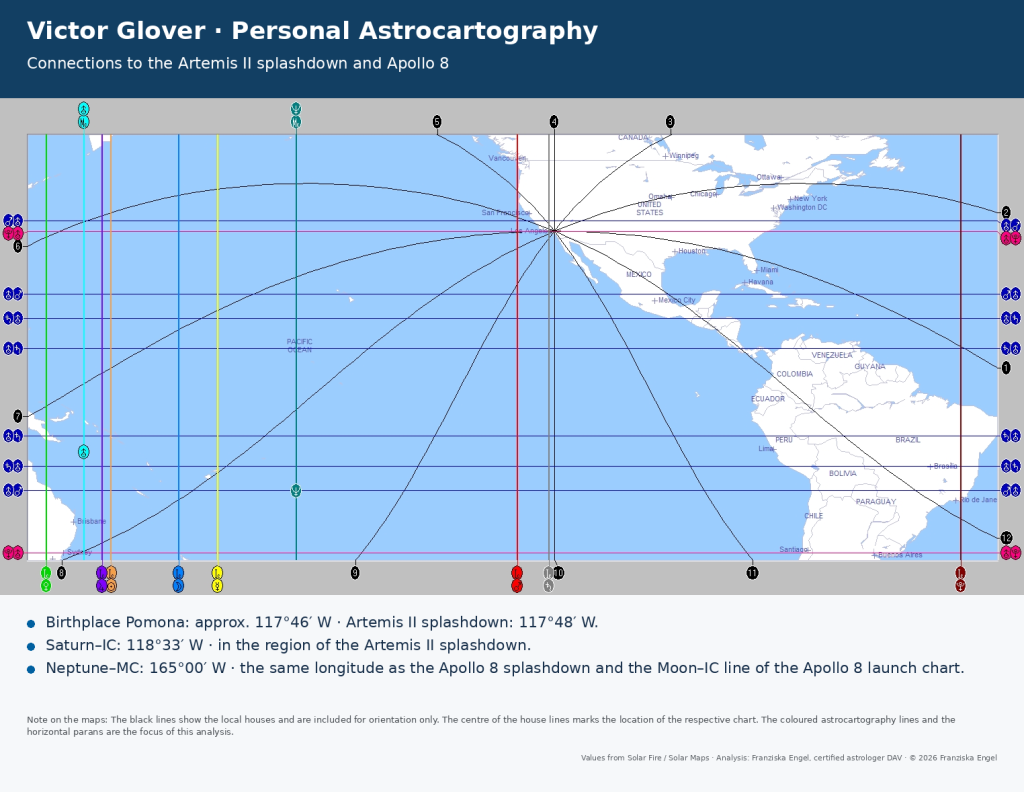
Victor Glover is the only one of the four astronauts for whom we have a reliable birth time. Glover was born in Pomona, California, practically on the same longitude at which Artemis II would splash down in the Pacific decades later. One might say: bull’s-eye.
His personal astrocartography makes the connection even more striking. Saturn is on the IC at approximately 118°33′ W, once again directly in the region of the Artemis II splashdown.
At the same time, Saturn rules Glover’s Capricorn MC in his natal chart and is therefore a significator of career, public impact and his contribution to society. Saturn itself is in Cancer, the sign of the Moon. Once again, the lunar theme appears.
Another connection takes us to 165° west longitude. In Glover’s astrocartography, Neptune is on the MC there. This is exactly the longitude at which Apollo 8 returned to Earth in 1968 and where the Moon was on the IC in the Apollo 8 launch chart.
If we relocate Glover’s chart to this region, another detail stands out: his Ascendant there is in Pisces. Using modern rulership, Neptune therefore rules this relocated Ascendant while simultaneously being positioned on the MC. At 165° W, another connection thus emerges between the personal astrogeography of an Artemis II astronaut and the return location of the first crewed lunar mission.
Half a Century and Recurring Locations
Apollo 8, Artemis I and Artemis II are separated by decades. The technological conditions changed fundamentally, the missions had different objectives and their charts were cast for completely different times.
This makes the geographical repetitions all the more remarkable. Moon and Uranus lines, as well as their parans, repeatedly connect locations of departure and return. Certain longitudes reappear across different missions and, in the case of Victor Glover, even extend into the personal chart of one of the crew members.
Astrogeography as a Method
I have been working intensively with astrogeography and its different methodological approaches for around 18 years now, and it has lost none of its fascination for me. Cases like this repeatedly reveal connections that would be difficult to invent.
An MC or IC line of a planet is not located arbitrarily somewhere in the world for a particular chart. It falls on one specific geographical longitude, and only once. Likewise, a paran, the simultaneous angular position of two planets at a particular latitude, activates a specific latitude.
When Moon and Uranus connections repeatedly appear at the actual locations of launch and return across events separated by several decades, a remarkable concentration emerges.
What Does This Mean for Your Own Chart?
The Artemis missions are an example from mundane astrology, but the same astrogeographical principles can also be applied to a personal birth chart. Your horoscope creates its own unique geographical patterns, connecting particular places with different planetary themes and potentials.
This can be especially valuable when you are considering a move, choosing between different locations, planning an international assignment or simply asking why certain places seem to play a particular role in your life.
In an individual astrogeography analysis, we can explore which locations are especially relevant to your chart and what they may mean for your personal or professional plans.